
In short. The types of syndactyly, why the timing of release matters for growth, and the flap and skin graft techniques used to separate joined fingers.
Key points
- The technical difficulty of syndactyly surgery is not dividing the fingers — it is covering them.
- Two fingers that shared one skin envelope now need two.
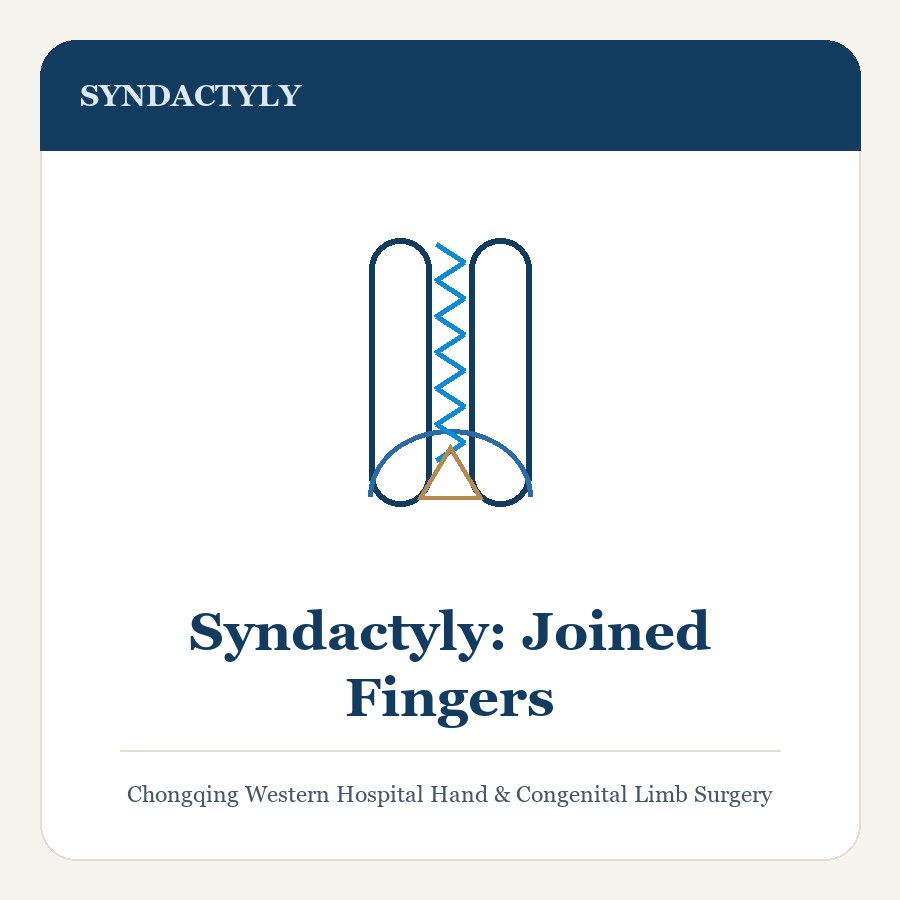
- Surgeons design zig-zag incisions so that the scar does not contract across the web, build a new web space with a local flap, and use full-thickness skin grafts, usually taken from the groin, to cover the sides of the fingers.
Syndactyly means fingers joined together. It happens when the webbing between digits fails to separate during early development, and it is one of the most common congenital hand differences. The joined fingers may be connected only by skin, or may share bone, joints, tendons, and nerves.
The types
Simple syndactyly involves skin and soft tissue only. Complex syndactyly involves fused bone. Complete syndactyly runs the full length of the fingers, while incomplete syndactyly stops short of the tip. The most familiar pattern joins the middle and ring fingers, but any adjacent digits can be affected. The border digits — the thumb and the little finger — behave differently because each borders a gap, and they are usually released early.
Why timing matters
Joined fingers grow at different rates. If the middle and ring fingers share a joint and are left joined, the longer finger tethers the shorter one and can force it to bend and twist as the child grows. That is a growth problem, not merely a cosmetic one, and it is the main argument for releasing fingers in the first year or two of life rather than waiting. Any syndactyly in which the fingers are clearly unequal in length is released earlier for the same reason.
Separation is a skin problem
The technical difficulty of syndactyly surgery is not dividing the fingers — it is covering them. Two fingers that shared one skin envelope now need two. Surgeons design zig-zag incisions so that the scar does not contract across the web, build a new web space with a local flap, and use full-thickness skin grafts, usually taken from the groin, to cover the sides of the fingers. Grafting is what allows the fingers to be released without tension, so grafts are expected rather than a complication.
Anaesthesia and the operation
Release is performed under general anaesthesia in an operating theatre. Only one side of a web is usually released at a time, so that the shared finger keeps a normal blood supply. The hand is placed in a bulky dressing or cast for a few weeks while the grafts take.
What it can and cannot achieve
It can give the child independent fingers, a web space of normal depth, and the chance to grow straight. It cannot make the fingers identical to unaffected ones. Scars remain, grafts differ slightly in colour and texture, and a minority of children develop web creep, where the new web gradually migrates toward the fingertips and needs a small revision.
Recovery and follow-up
Dressings come down at around two to three weeks. Hand therapy and scar care follow, and growth is reviewed until skeletal maturity. Final assessment is at twelve months or longer. Results are generally good, but they are never guaranteed.
Seek care if
- Fingers become pale, blue, cold, or markedly swollen inside the dressing.
- The dressing becomes wet or foul-smelling, or the child develops a fever.
- The child cries persistently with the hand held still, or a finger looks dark.
Frequently asked questions
Why are joined fingers released in the first year or two?
Because joined fingers grow at different rates. If the longer finger tethers the shorter one, it can force it to bend and twist as the child grows, which is a growth problem rather than only a cosmetic one.
Why is a skin graft used when separating fingers?
Two fingers that shared one skin envelope need two once separated. Grafts taken from the groin or another site cover the sides of the fingers without tension, so grafting is expected rather than a complication of the operation.
What is web creep after syndactyly surgery?
It is when the new web space gradually migrates toward the fingertips as the hand grows. It affects a minority of children and may need a small revision. Dressings usually come down at around two to three weeks.
Risks & Limitations
- Incomplete return of sensation or movement. Nerve recovery is slow — roughly a millimetre a day — and some feeling or movement may never come back.
- Stiffness and contracture. A stiff hand is the commonest reason a technically good operation gives a disappointing result.
- Rupture of a tendon repair with forceful use too early in the protected period.
- Infection, which may require antibiotics and further surgery.
- Scarring and scar contracture. Scars are permanent, may stay sensitive or cold-intolerant, and can tether a joint or a web space.
- Growth disturbance in children, which may require later surgery as the hand grows.
- Prolonged hand therapy. Splinting and graded exercise are part of the treatment, not optional aftercare.
- No outcome is guaranteed. Final assessment is made at 12 months or longer, and longer still in growing children.
When to Seek Care
- A hand that becomes pale, cold, blue or numb, or fingers that change colour.
- A wound that becomes red, hot or discharging, or a fever above 38 °C.
- Sudden loss of movement after tendon repair, or a pop felt in the finger.
- Severe pain or swelling in a cast or splint, or a splint that has become too tight.
- Bleeding that does not stop with gentle pressure.
- New or worsening numbness or weakness at any stage after surgery.
References & Further Reading
- American Society for Surgery of the Hand (ASSH) — hand and upper limb condition guidance
- American Society of Plastic Surgeons (ASPS) — reconstructive and hand surgery guidance
- Cochrane Library — systematic reviews in hand surgery and hand therapy
- Chinese Medical Association, Plastic Surgery Branch — clinical guidance
This page is patient education, not medical advice, and it does not cite individual studies. Discuss your own case with a qualified clinician. To arrange an assessment at Chongqing West District Hospital, see Contact & Consultation.